“Campusing” and Our Work in the Archives

An Abbreviated List of Women’s League Rules Found in the Archives

  • Always sign out on your Out-Of-Town card when leaving campus.
  • Men are not allowed at the Women’s League Cabin at any time. Dates may not escort you to the cabin.
  • Drinking beer, wine, or hard liquor is not allowed in the cabin.
  • If you smoke inside or outside the cabin, be sure your cigarettes are entirely out. Don’t smoke in bed!
  • All freshmen, sophomores, and juniors must return to their dorms before 10 pm each night – senior women may return at 11:15 pm. After 11:15 pm, dorms will be locked.
  • Permission to stay at a hotel while a student at Carleton must be obtained from the Dean of Women’s Office. 
  • Male students may be in Women’s dormitories except during meals. 
  • Women are only allowed into Men’s dormitories for special occasions. 
  • Alcoholic beverages in any form shall not be possessed or permitted on the college campus or at college-sponsored events. 
  • No delivery of food or other items may be accepted into dorms.
  • Only at an appropriate time of day, and upon securing permission from her RA, a student may escort male family members to her room.
  • Slacks, shorts, or jeans are not to be worn downtown, to classes, to the library, or in dormitory dining rooms. 
  • Warm slacks or ski pants may only be worn when temperatures are below zero.
  • Pantyhose and dress shoes with a dress or suit will be worn to dinner on Sunday and Wednesday.

The Women’s League rules changed several times over the decades. Women in the league began their term with ten points, and each infraction incurred a loss of one or more points depending on its severity. If a student lost all of their points, they would be “campused,” meaning that for a period of up to three weeks, they would be sequestered in their dorm beginning at 7:00 pm. During this time, there would be no phone calls and no visitors and the “campused” women were required to submit a list of extracurricular activities to the house president. In addition, they were prohibited from participating in these extracurricular activities for the duration of the “campusing.” The rules do stipulate, however, that a senior who was “campused” during the last month of school may appeal to the Women’s League Court for permission to attend senior functions. 

In the Women’s League Court, the offending student’s peers would settle issues regarding the campusing system. This “women-against-women” atmosphere eventually led to the downfall of the Women’s League, as students began to protest the restrictive rules enforced by their peers.

Sherry Nelson: A Case Study

One example of the Women’s Court’s role in a campusing dispute is the case of Sherry Nelson in 1968. These Women’s League minutes, transcribed below, give details about her appeal hearing.

Figure 1: Women’s League meeting notes found in the Carleton Archives

Transcription:

Sherry Nelson Jan 9, 1968

Lost her last point. Wants to appeal previous points. One for not signing a sheet in the dorm sheet booth and another for lateness due to an incorrect clock. (slow).

Point 1: the sheet was paid for – all was legal – except she didn’t sign in at the proper time

Point 2: called in Friday to sign out with plenty of time to Willis clock. Time was busy and by the time she got connected it was late by Gridley clock. Mary Fiebiger however was seeing complaints that Gridley clock was fast that night.

Neither point was her last. Someone had warned her that appeals of any points should be made when all are lost.

Appeal: Campused. 7 days.”

Interpretation:

This example shows the severity of the Women’s Leagues rules and regulations. Nelson’s excuse seems reasonable enough: a slow clock could make anybody late. The presentation of testimony from other students who claimed that the Gridley clock was fast, however, undermines Nelson’s claim while showing just how seriously these rules were taken within the strict, peer-governed environment.

Music Studies

Carleton Farm and the Olin Farm

By Dani Reynoso, Sara Negasi and Bladimir Contreras

Our final project is focused on the Olin Farm during the period it functioned as a farm for Carleton College. We created a story map, here’s the link to it: https://arcg.is/0u4ee

Like many other Midwestern colleges at the time, Carleton took part in the purchase of farmlands in order to help provide for their student body. Carleton itself purchased multiple other farms in the immediate area to the Northwest of campus. Some of these include the Parr Farm, Peterson Farm, and Arnold Farm.

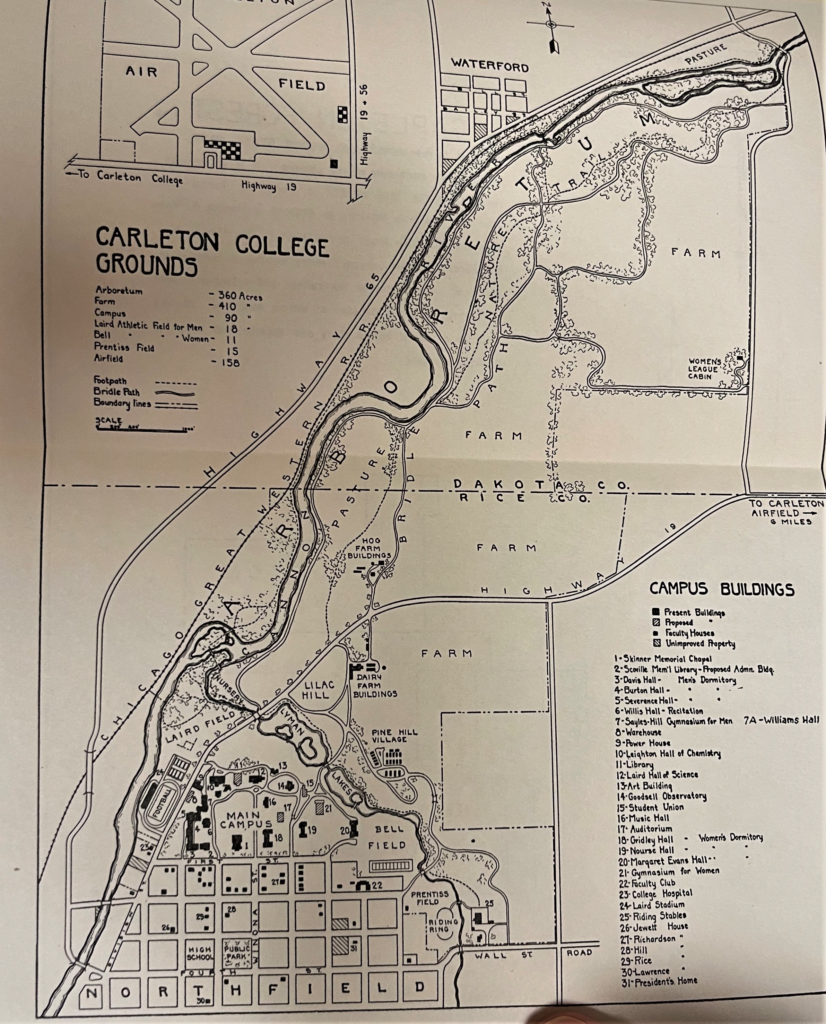
A drawn map of campus from around the 1950s

Our project is focused specifically on the Olin Farm area, which is the area labeled under ‘Hog Farm Buildings’.

The map below depicts the layout and dimensions of the Olin Farm with the farmhouse on the right and the hog barn, granary and chicken house on the left.

1941 Insurance Map of Olin Farm

Our research question was guiding by the fact that so much is unknown about the Olin Farm separate from the Carleton Farm and so our goal was to try and learn what life was like on the farm for students and workers as well as to understand the purpose for Carleton’s purchase of the 100 acre farmland.

1916 Deed of the Olin Property when Carleton bought it

Our timeline begins with the purchase of the Olin property by Carleton in 1916. It was bought with the intention of being able to feed more students who were enrolling into Carleton and it was a very common purchase for the school.

Carletonian article from 02.18.1922

The above article clipping is from the school’s newspaper that stated Carleton students were able to work on the farm to pay off their room and board. Other archived fiscal reports detail how the house was also rented out to people who would come to work on the farm. The last record of the house being rented out was in 1963 when a man named Norman Johnson paid $660 to rent the Olin residence for a year.

Carleton Farms Fiscal Report, 1944

The above note addressed to President Cowling describes how the farm was becoming difficult to maintain thanks to crop failures and a decrease in income from the property. The 1964 letter below is from the Treasurer’s Office and it shows the decline of the Carleton Farms (including Olin) and the college wanting to rent the property.

The last financial record of the farm is from 1964 so we assume that the land was maintained by the school as a former professor currently occupies the house. It is also now part of the area that is known as the Cowling Arboretum, and so the land surrounding the house consists of a nature path.

Overall, he hope that our project is able to present and explain in an engaging way the history of the Olin farm from 1916-1960(ish). All the information above including texts, images and documents, can be used to explain possible functions of the Olin/Kelley Farm. Lastly, thank you for reading this far, we truly appreciate it. If you have any questions, comments, concerns, input, etc. regarding the entry above, feel free to reach out to us via email contreasb@carleton.edu, negasis@carleton.edu, reynosod@carleton.edu. We’ll be more than happy to connect with you 🙂

3-D Scans

A fragment of a bowl, with blue and yellow stripes not visible in the scan, found in excavation unit seven.

A fragment of a cow femur, found in excavation unit six.

Can, with church key indentations visible in top, found in test unit 11.

Timeline of Excavated Data

By Kyra Landry

Week 8 (Wednesday Lab)

During this week’s lab block, students in the Wednesday lab group were granted a third and final day of fieldwork, since last week’s rain had cost them one last week. We were fortunate enough to have good weather, but evidence of earlier rain could be seen in the fungal growth, wet soil, and speed at which the Cannon river flowed past the mill site. As in previous lab periods, students split up into working groups focused on DGPS mapping, locating and recording information about archaeological features, and continuing excavation in the two trenches. As this was the last day that either lab section would be working at the Waterford mill site, extra steps were taken at the end of the lab period to clean up the site. Particularly, all the metal stakes and bright pink tape that had been placed throughout the site during initial surveys were removed. Trenches were not backfilled, as we had not penetrated enough layers of soil for that to be necessary. Additionally, the state of the trenches after recent storms illustrated the speed at which they would soon be naturally filled.

Over the previous excavation days, several features were identified but only on the last day of lab were they fully mapped. This was both on paper, with sketches of each of the sites, and using the GIS mapping equipment. One of these features was the back wall of the second mill building, which was connected to another wall closer to the original site. In the process of following each of these formations, a pile of cans and various pieces of colored glass were found along one of the walls. The GIS team mapped each of these locations in order to get a more complete picture of the site. Another group was in charge of drawing some of the features and locations around the mill, such as the lower section of the main mill building closer to the water. Because of its proximity to the river and a rainy spring, we were not able to excavate there, nor were we able to excavate near the wall further along the river by the campfire. However, the GIS group mapped each of these locations as well, meaning future iterations of this class have a head start if they choose to do more excavations at the mill site.

The final day of excavation was quite productive, with both excavation groups getting through a good amount of depth, and putting several buckets worth of dirt through the sifter. Both excavation groups contended with the dampness of the soil as a result of recent rains, in addition to coming to the end of the high artifact density that near-surface excavation at this site yielded.The four students working in the first trench worked in subgroups of two, so that while one subgroup was sifting a bucket, the other was proceeding with the excavation and working on filling another bucket. The group working in the trash pit trench found, as in previous weeks, copious amount of charcoal and metal scraps, in addition to several pieces of glass, plastic and ceramic. Of particular note were a large metal item, which may have been an automobile component, a ceramic sherd that bore the name of the company that manufactured it, and a hollow, bulbous item that could have been either ceramic or rusted metal. Less was found in the second trench, as was consistent with the other excavation periods. Students excavating in the wall trench found a smattering of nails and metal shards, in addition to a large piece of a ceramic artifact. By the end of the excavation period, both groups ensured that they flattened the floors of their trenches, as well as removed the corner stakes and the perimeter tape surrounding their trenches. Trenches were left in such a state that nature could take its course in refilling them.


Week 7 (Wednesday Lab)

IMG_3492

Img 1. Look at those branches!

Week 7 Summary by: Emily Moses and Sam Wege

Beautiful Weather, Drone Failure, a Deadly Tick, and a Fired .22 Casing

Sun!

“Under the Scorching Sun” – Maanya

Attempted Drone:

Though we tried to get drone data, due to restrictions around telephone lines and railroad tracks and general tree cover it wasn’t possible. Hopefully in coming weeks we can obtain drone footage.

Mapping: 

WM weekly summary test.jpg

Img 2. DGPS points from the Waterford Mill site on May 14 and 15

IMG_3403

Img 3. Clarissa and Loren mapping with the DGPS

Findings:

Pictured below are some of the findings from trench 2, which are explained in the trench 2 section.

Trench 2: Context 3

IMG_3384.JPG

Img 6. Trench 2 before Wednesday’s excavation

Annie, Aaron, Clara, Hank, Emily and Sam excavated in Context 3. This was the first time excavating for all of us (Aaron was our mentor as he was an experienced trowler from his previous work in Israel and Jordan with Barbara). As Sam mentions in his fieldnotes, previous groups had mislabeled contexts which made it confusing to identify the context Wednesday’s lab was working in.

After establishing context 3, they began excavating working as flat as possible to evenly excavate the site. This was challenging, as it was tempting to dig in areas where there were clearly artifacts protruding. Additionally, as Clara mentions, there were possibly too many cooks in the very dirty kitchen which made communication very important–making sure that everyone was still troweling and clearing at about the same level. Each excavator used a trowel and dust tray–holding the trowel at 90 degrees in order to disturb the stratigraphic layers as little as possible–and swept thin layers of dirt into the pan. Dirt was emptied into large buckets. This process was time-intensive and exhaustive, but rewarding. A few ticks were found crawling, which caused for a minor panic, but they continued work. After buckets were filled, each bucket was brought to the sifter so that hidden artifacts could be uncovered.

As excavation was happening, Annie and Emily took turns drawing a sketch of the various artifacts and rocks as they were being uncovered on the Excavation form.

For bucket one, Sam poured the contents of the bucket onto the sifter as Hank moved the sifting device back and forth; this process surfaced items such as nails and bullet casings, letting the rest of the dirt fall to the ground. This process uncovered charcoal, nails, plastic, bone marrow, shells, and a .22 bullet casing.

Trench 1: Context 4

IMG-3123.JPG

Img 9. Trench 1 being excavated

Arya, Maanya, Miyuki, Price, and Sam worked to excavate trench 1, specifically context 4. This group had a similar process to that of those working in trench 2, and followed the same excavation techniques. This group, however, was working much deeper than that of trench 2. As Maanya discusses in her fieldnotes, they conducted trail trenching–digging the site solely for its archaeological findings and potential.

Following the sifting process, this group separated findings by material, bagged findings, and labeled the bags appropriately. Some interesting finds from this group included metallic springs, a (potentially) glass coaster, some pottery pieces, and a few nails.


Interpretation:

The abundance of charcoal found could be indicative of the mill’s original time in use. In our research about mills, we have learned that they catch fire quite often because the powder released during the milling process is extremely flammable. One local mill that burned down multiple times as a result of this is the Archibald Mill – we hypothesize that the same thing could have occurred here. One further question we could pursue to seek out an answer to whether or not this is the cause of the charcoal would to be to do some sort of analysis on the walls that remain in the mill to see if they have remnants of ash on them. Another possibility is that the charcoal is not the result of a mill fire, but rather from site usage after the end of the mill’s functioning.

Additionally, we found many nails (pictured above), which were greatly rusted. Perhaps these came from the mill’s construction or mechanisms which existed within it. Furthermore, many of the nails are bent or broken, indicating that they were used for something heavy or as support. It is difficult to tell without further analysis, but given the layer at which they are buried and the damage they underwent, we are hopeful that they prove to be from the time of the mill’s use. One potential next step might be to analyze the different nails used and the construction practices of the time. We could compare this research to the nails we found to get a better idea of whether our nails come from the mill’s initial occupation or not.

As far as more contemporary occupation, we found a .22 casing, which is potentially from a more recent time than the mill’s use. With more research regarding the hunting and firearm practices throughout the last couple centuries, we may be able to figure out approximately when the bullet was fired. Depending upon the time at which the bullet was fired, it could raise a few different questions. If it is from the time of the mill’s use, then we should search the Waterford records to see if there was any news of something being fired, intentionally or unintentionally, at the mill. Alternatively, if it is more contemporary we could try to find more bullets or casings to see if we can piece together a pattern of why/when they were fired.

[wpvideo M6DTOPlg]

Vid 1. Aaron demonstrating wonderful brushing technique to excavate trench 2, while Annie ponders the realities of the earth.


Week 6 (Wednesday Lab)

Aaron, Maanya, and Apoorba
Archaeological Methods
May 10, 2019
Weekly Write-up- Week 6

Due to inclement weather, the Waterford Archaeological Team (WAT) worked on artifact cleaning inside the classroom instead of traveling to our usual fieldwork location at Waterford Mill. Our objective was to organize the artifacts into groups based on their material categories. We washed and sorted the collections that we had discovered up to this point from the fieldwalking survey, the gridded survey at the Waterford Mill site, and excavation trenches 1 and 2. Due to the variety of artifact sources, we divided ourselves into groups with each team assigned to artifacts from a particular trench context, survey unit, or gridded survey square.

Unpacking:

WAT carefully unpacked the artifacts from their bags unloaded them onto trays for thorough cleaning.

20190508_170654.jpgFigure 1. A cardboard box containing artifacts from the Waterford Mill Archaeological Site.

Organizing the forms:

As WAT moved on to the organizational step of the archaeological process, forms and paperwork took the central stage along with the material collections. Sam W. and Clarissa organized the forms and rechecked the data to match with the material collections. Clarissa proceeded to make an inventory for the washed and unwashed bags of materials to help accelerate the process of analysis over the coming weeks.

20190508_153955Figure 2. Sam W. and Clarissa maintain an organized structure for keeping track of the locations and labeling conventions for each artifact source.

20190508_152957.jpgFigure 3. Sam W. and Clarissa report to Professor Knodell regarding their task. Meanwhile, Sam A. and Loren remove dirt from ceramics of Trench 2.

Division of labor:

Everyone divided into teams to keep track of the artifacts we were cleaning. Maanya, Arya, Lena and Miyuki undertook the cleaning process for the materials collected during the field walking surveys. Aaron, MJ, and Holland worked on material remains recovered from trenches, the primary artifacts being from trench 1, context 2. Emily, Anne, Clara, Sam A. and Loren focused on collections from the gridded surveys.

Brushing the dirt off:

This was a crucial step in the archaeological process since it enabled us to get a better understanding of what the artifacts looked like before they were buried under piles of dirt and soil. The groups used toothbrushes or a tool brush to clean excess dirt from the outside of the material. Brushing off the dirt off was essential especially for materials that could not be washed. For the metal remains, the group used subjective judgement to distinguish between diagnostic pieces and pieces that lacked diagnostic qualities. They used a toothbrush and paperclip to clean the dirt off of the surface of the diagnostic pieces, which are more valuable to archaeological interpretation than non-diagnostic pieces. We appreciated the wide range of objects that the various survey groups and excavators had collected since they each have a story to tell about the mill’s past.

20190508_153004Figure 4: Maanya starts off the cleaning process for her materials by brushing the dirt away using the tool brush. Taking the dirt off beforehand makes washing easier and less muddy.

Wash em clean:

Next, for all materials other than metal, we used water to finish the cleaning process. Water was avoided for metal and other biodegradable materials to prevent further erosion and degradation. We used the LDC bathroom taps to wash the artifacts clean, and wiped them off with paper towels after. This was especially difficult for hollow objects like cans, the inside of which had to be cleaned before moving on to its surface. We encountered a number of earthworms and bugs that had found a home in the unwashed artifacts. These had to be washed off before the artifact could be dealt with. Cleaning the glass and ceramic objects proved relatively easy. The objects that were collected during the rain-showers were harder to clean because the dirt was damp and stuck to the surface, whereas for the artifacts gathered on the clear days, simple dusting and brushing proved sufficient.

20190508_153737Figure 5: Clara and Anne team up to wash the artefacts from the gridded survey while Arya shows her solidarity by recording this wonderful moment. (You’re welcome!).

Drying:

Finally, the artifacts lay on clean trays to dry off. Paper towels also came in handy to speed up the process as we had limited time and a few more steps to fulfill.

20190508_153746Figure 6: Emily takes the assistance of paper towels to accelerate the drying process.

Like with Like:

The team counted, bagged, and labeled the non-diagnostic pieces, and placed all other artifacts in a distinct bag according to material. Then, the smaller bags were placed in a larger bag labeled for the square and context from which the artifacts were recovered. We labeled the initials of the person who had undertaken the survey, the type of material placed in the bag, and the survey unit/grid that the materials prescribed to. Sam W. and Clarissa traveled to each table and documented the numbers of each material type on Clarissa’s computer, which could then be used as a data set in future analysis.

img_5130.jpgFigure 7: Good organization allows us to keep artifacts organized by their context, so that we do not lose valuable information about any of our materials by failing to record where they were originally found in site. In this image, Aaron, MJ, and Holland have created a tray of objects exclusively from Trench 1, context 2, and have also divided the objects according to their material.

The future accountants:

On Thursday, Aaron, Arya, and Maanya went to Alex’s office hours where he showed us all the artifacts that had been collected by the lab groups (and gave us coffee!). Following this, we produced an inventory of which artifacts had been cleaned and which artifacts still needed to be cleaned:

Trench washed:

Trench 2, context 1- 1 bag (plastic)
Trench 1, context 1- 3 bags (glass, ceramic, metal)
Trench 1, context 2-  5 bags (metal, other, metal scrap, pottery, glass)
Trench 2, context 3- 4 bags (glass, leather, metal, ceramic)

Gridded Survey washed:

F12- 4 bags
H11- 3 bags
F-11- 1 bag of metal
F-10- 1 bag of other
H-12- 4 bags
H-13- 2 bags
H-10- 3 bags
G-11- 1 bag
G-12- 6 bags
G-13- 2 bags

Fieldwalking washed:

SU W1-01- 5 bags
SU W1-02 – 3 bags
SU W2-01- 4 bags
SU W2-02 – 7 bags

Trench unwashed:

Trench 1, context 3 – 7 bags
Trench 2, context 2- 1 bag

Gridded Survey unwashed:

G-11 (6 small bags in 2 big bags)

Fieldworking unwashed:

T2-01 – 16 bags

Blog it!

After each week of fieldwork, each member of WAT publishes a summary of his or her contribution to the project website, or blog. Finally, a designated group of team members creates a blog post each week to capture a holistic summary of all the work completed for that week, giving everyone a better sense of where we are in the process of our excavation. Additionally, this website is available to the general public for anyone interested to learn about the project.

59803229_2252253348424402_2038175849848504320_nFigure 8: Future archaeologists (from left to right: Aaron, Maanya, Arya) summarize WAT’s hard work from week 6 outside the Carleton College Classics department. WAT values civic engagement through archaeology, which is why we publish our process and research for the public to view each week on our website.  

Fun Fact of the week:

Alex “the Barista” Knodell makes bomb coffee. Drop by his office hours to witness the magic (Again, you’re welcome!).

IMG_5140Figure 9: No caption needed.


Week 5 (Wednesday Lab)

Pre-Lab

During the Wednesday lab at the Waterford Mill site, we continued our archaeological work by continuing mapping, survey, and excavation. The class divided into three groups: a mapping group (3 people), a surveying group (2 groups of 3 people), and an excavation group (6 people).  

IMG_2028

Figure 5.1: Trekking along the railroad, mentally preparing for our surveying exploits.


Mapping

Hank, Clarissa, and Aaron were in charge of mapping for this week. The focus was first to lay out the last points for the grid. In laying out the grid, they noticed that while the points are supposed to be five meters apart, most of them were not exactly five meters apart. This discrepancy was likely caused by both human error in measuring the land and by the uneven landscape.  They then took points at the corners of the excavation trenches and  in the middle of the trenches to figure out the depth of the current excavation. Analyzing this depth will be useful as we later consider how artifacts and their context relate to their position or depth in the soil or ground.

mapping2

Figure 5.2: Almost levitating.

grid 2

Figure 5.3: A Google Earth depiction of all the points that have been mapped with the GDPS, with Tuesday lab group points in blue and the Wednesday lab points in red.

grid and lines

Figure 5.4: A depiction of mapping points and their correlation to their surroundings: the yellow lines represent the mill walls that were mapped, the white circles represent the excavation trenches, and the pink lines represent the survey units.


Survey

We split six people into two groups of three and each surveyed the units which were not  yet surveyed. The units left were H10, H11, H12, H13, and G13. Group 1 surveyed H10, H12, and H13, while Group 2 surveyed H11 and G13. Alex advised us to survey one unit for the first ten minutes and then to start counting the artifacts we found in that survey unit. If we do not set a time limit, our surveying could last years, maybe even a lifetime. Our archeology labs only last two hours. During our survey we took pictures of each artifact and wrote down the number of artifacts we found, which we classified according to material types. We also drew a sketch of each unit to show where each artifact was found.

Survey Group 1: Loren, Miyuki, and Sam

Sam was in charge of note taking and Miyuki and Loren surveyed the unit and counted the artifacts they found. In the inner units, we more likely to find artifacts which seemed related to the site itself.  In outer units, especially H13, we more likely to find artifacts thrown in the unit from the outside relatively recently. We started to think about and investigate the spatial and chronological relationship of the site and artifacts, especially in the articles of trash we found. We found different kinds of artifacts in different locations and units, and we would like to think about how the locations of these artifacts reflect on or reveal something about the different types of people who disposed of these things in these units.  

IMG_2034

Figure 5.5: The gang huddling before the big dig.

H10

Figure 5.6: Survey Unit Form of H10

survey.JPG

Figure 5.7: Sam and Loren eyeing the earth.

IMG_7252

Figure 5.8: Glass lost

h10-1.jpg

Figure 5.9: Glass found

H12

Figure 5.10: Survey Unit Form of H12

H13

Figure 5.11: Survey Unit Form of H13

Survey Group 2: Emily, Lena, and Annie

Emily was in charge of sketching, outlining product features, and Annie and Lena dug in the dirt for findings. We found a maroon palm-sized fragment of pottery, roughly 14 pieces of glass, an old bag of chips, and a tiny clamshell, among other things. Surveying G13 was particularly difficult, as prickly branches covered the ground and we had to be careful not to let the thorns seep into our clothing and prick our skin. Despite this obstacle, we did find one shell fragment, and got some good practice clearing brush. How does contemporary archaeology make it possible to reveal the relationship between the site and the people who used it chronologically and spatially?

IMG_2032

Figure 5.12: Lena finding glass stuck between a rock and a hard place.

IMG_2038

Figure 5.13: Dirty glass


What does the spatial distribution of the found artifacts tell us about their chronology? Can we infer anything about the people who used this site from the spatial distribution of the artifacts?


Excavation

For excavations, we again split six people into two groups of three.  The first group was Price, Holland, and MJ, and the second group was Sam, Arya, and Maanya.  The groups discussed with Alex about whether new 1m x 1m excavation trenches should be started, or whether they should continue working in the excavation trenches created by the Tuesday lab group.  The decision they reached was to continue the excavations started on Tuesday and pick up where they left off.

image2

Figure 5.14: Trench 1 Pre-excavation on Wed

image3

Figure 5.15: Post-excavation at the end of the lab

The first group excavated the trench that was next to the trash pit, which was identified as trench 1.  They trowelled the area and used dustpans to remove excess dirt. The trench was on a slight slope and was just above the trash dump, which made excavations a little trickier, so the dustpans were easier to use than a shovel would have been. They found a lot of rusted metal pieces, broken glass, and broken ceramics, which were all bagged, after sifting their excess dirt.

ExcavationForm

Figure 5.16a: Excavation form for trench 2

ExcavationFormBack

Figure 5.16b: Excavation form for trench 2

The second group excavated the trench next to the lower wall, which was identified as trench 2.  They shovel shaved and trowelled the area, removing several roots and digging around embedded rocks. They found mostly metal scraps and nails and bagged them and sifting their excess dirt.

unnamed

Figure 5.17a: Excavation trench 2

unnamed

Figure 5:17b Excavation trench 2

This week, our finds included rusted pieces of metal, broken glass, and broken ceramics. These finds tell us that people may have gathered around this area to eat or dispose of eating or food containers. From these finds, we can learn about the material culture of the area. As the mill was an industrial site, it makes sense that we found a collection of rusted metal fragments. It also makes sense that we found so many pieces of glass as trench 1, as it is located next to a trash dump. People often dispose of glass and related materials in trash dumps. We wonder who used this site as a trash dump: men in the mills, nearby farmers, or both? Our further excavations may be able to help us answer this question. Looking into historical records to see if we can find records of this dump would also help us determine who used this dump.


Lab Highlight

About halfway through the lab, as Lena and Annie were clearing brush, Emily turned around toward the railroad track and bid an enthusiastic “Heeey!” to the void. Lena and Annie were confused. It turned out that Emily thought the goats who were bleating were people saying hello to her. As a good citizen of archeology 246, she had to return the greeting.