Group Members: Will Clausman, Brian Thevenot, Santiago Enanoria
Background:
While Carleton College’s farms today exist as student interest projects, historically Carleton’s farms were created and maintained for the sake of generating revenue. Furthermore, Carleton’s investment portfolio has historically been in large part made up of agricultural investments. We wished to understand the transformation of Carleton’s endowment and farming community from a revenue generating experience to what it is today. To understand this question, our group combed through hundreds of documents in the archives and interviewed people on financial aid to get a better understanding of the financial impact that these farms had on Carleton as well as the legacy that they leave on our campus today.
One of the things we learned in conducting interviews and going through archive reports is that the Carleton farms were an investment for the financial aid office. Similar to how the current financial aid office invests in the stock market today, the business office of Carleton invested in farms as a means to facilitate the generation of passive income and grow the endowment. At the time most of these farms were acquired, farming was still a driving force of the US economy. Prior to the mid 1900s, the United States was a goods-based economy, meaning their GDP was dependent on the production of commodities. Therefore, we believe that the logic behind the purchasing of farms was in line with this economic context.
Method/Data Collection:
In order to create a clear dataset of farm finances, we consulted archival data relating to financial operations on the Carleton farms as well as investment data between 1931 and 1964. These documents were able to tell the story of the financial history of the farms, not only why the Carleton farms closed, but why Carleton did not continue to invest in agriculture.
The following graph is a simple representation of the Carleton Farm from the 1930s to the early 1960s, highlighting the profits for each year:
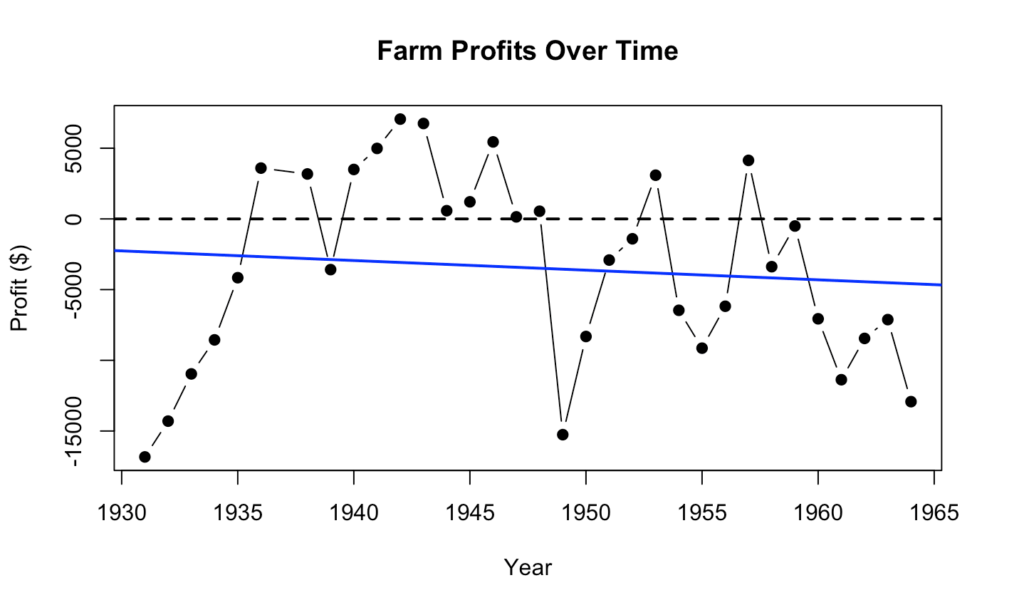
One of the things that stands out from this graph is the fact that it wasn’t profitable over these thirty years or so. The blue line is a best fit line plotted that essentially represents the downwards trend and loss in profit over those thirty years.
In an attempt to try and understand the overall loss of the farm, we were focused on trying to understand which departments of the farm were contributing to this loss of profit. To do this, we looked through financial reports that essentially broke up each department of the farm into little sections. The most profitable section of the Carleton farm was the field department, or in layman’s terms, the department that grew crops. Below is a graph dictating the profits of the field department:
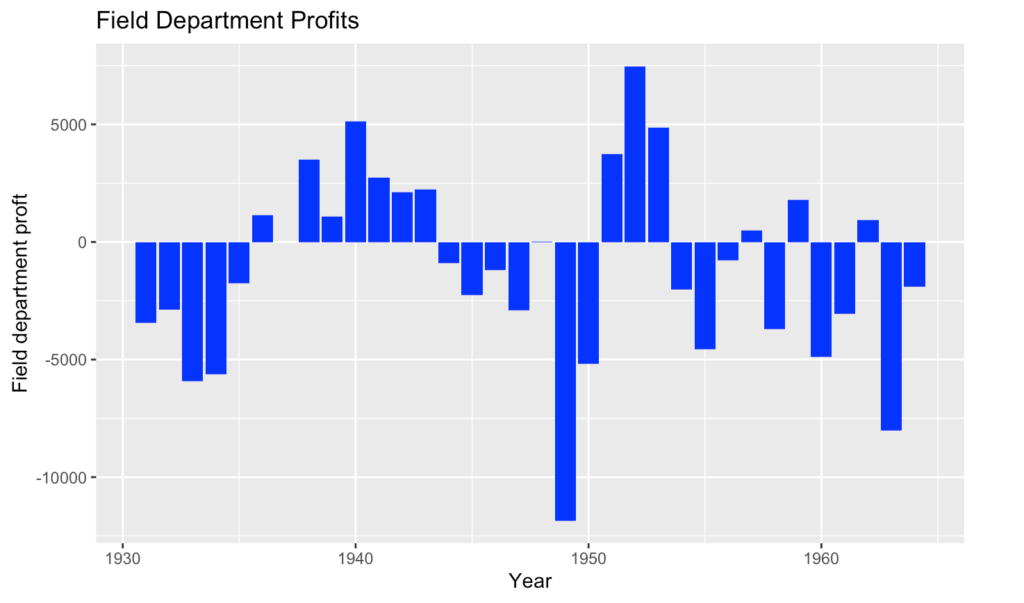
Despite it being Carleton’s most profitable department, we discovered that it was still losing a lot of money. However, this loss in funds is nowhere near the amount of losses that the hog department had lost.
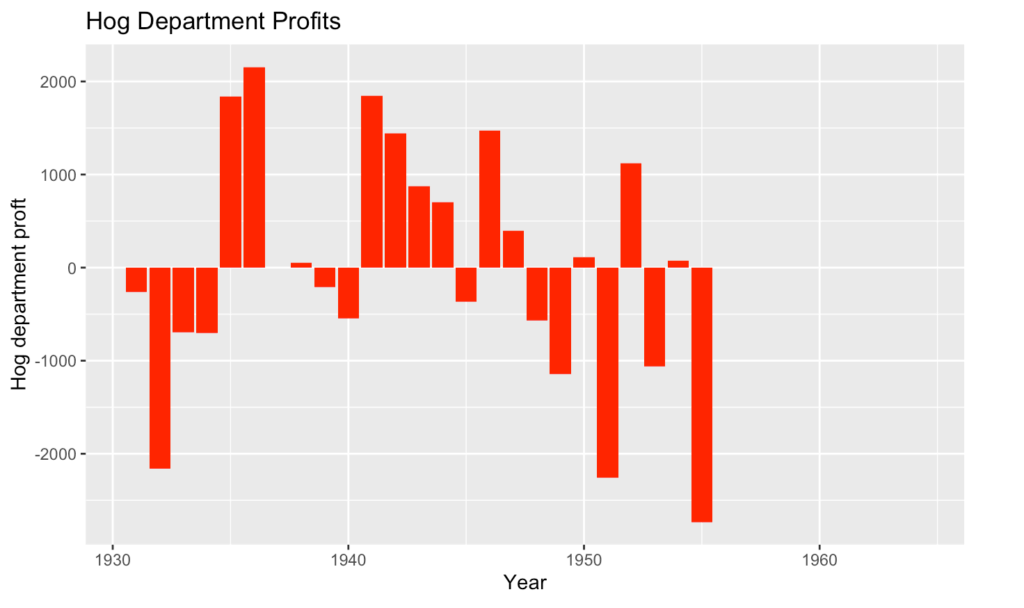
The hog department was one of the most expensive, and least profitable portions of the Carleton farm. Despite it making a lot of money, it also lost a lot of money as well. In fact, the hog department ended in the mid 1950s, well before the Carleton farm closed down. The following is the profit of the farm from the 1930s to the mid 1950s.
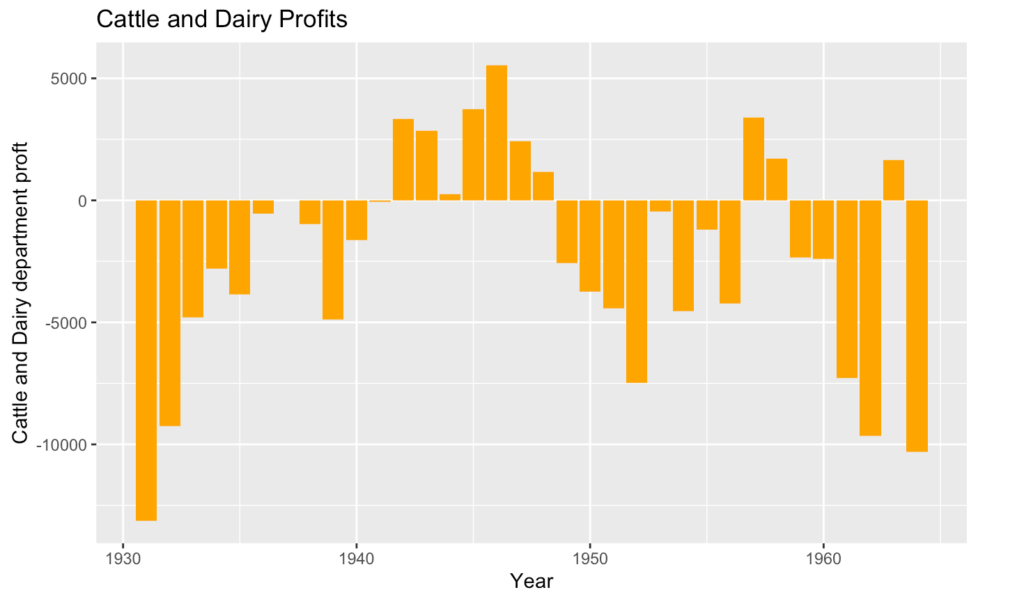
One department that remained open similar to the field department was the cattle and dairy department. This was another department that wasn’t as profitable and likely contributed to the downfall of the Carleton farm. Below is the profits from this specific department:
The following graph depicts the number of off-campus farms bought over time. The majority of these off campus farms were bought prior to the 1940s, though more farms were purchased during World War II. This is an important detail as it speaks to the historical standpoint within the United States. During World War II, the United States government needed food to help their soldiers abroad. In order to achieve this high demand for food, they decided to subsidize farmers, essentially purchasing all of their surplus to send overseas. This detail is especially relevant to this project because it shows how Carleton was able to buy so many farms and why they were so profitable during wartime.
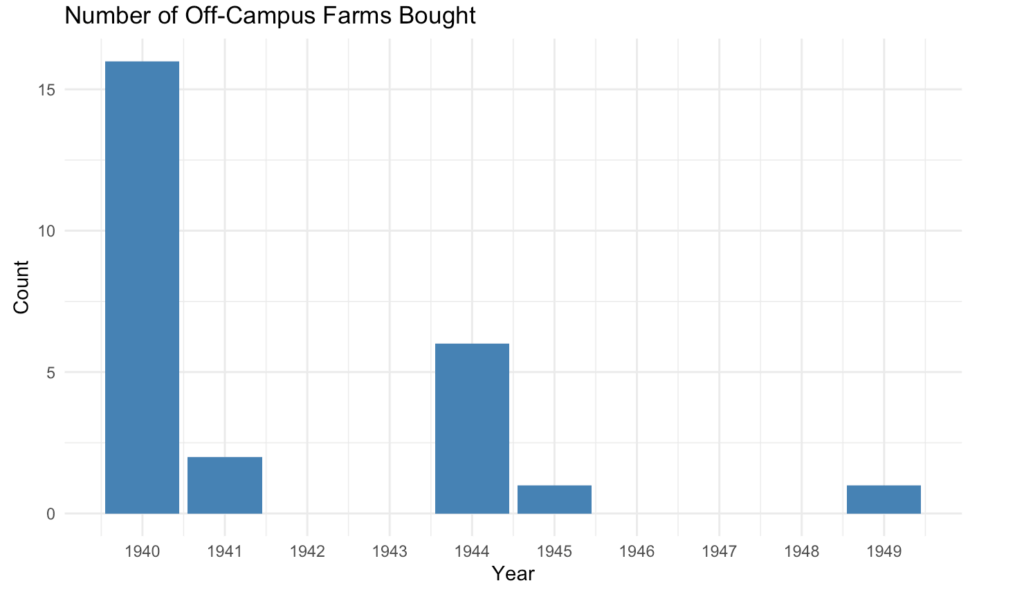
Despite Carleton’s push to grow their endowment, they were investing in a business that wasn’t profitable, or helping financial aid. In fact it was doing the opposite. Carleton’s farms were struggling to maintain revenue and grow as a business. Furthermore, their costs continued to rise due to the rapid-changing economy in the mid 1960s. It was becoming a burden to maintain rather than an investment.
To understand the relationship between Carleton Farm and financial aid, we utilized two sources: primary source documents between the business office and financial aid, and also interviews with the current financial aid office to understand the ways in which they use their endowment. We decided to use these two because our project was more driven by quantitative data, trying to understand why the farm no longer existed. As we were undergoing our excavation in class, we realized that to answer our research question, we needed to use archival data in order to answer our question. As a result, we decided to focus our efforts on these two sources to ensure that we were getting an answer to our question.
To collect our data we set up various meetings with the data archives and we took the numbers from each year’s fiscal reports starting with 1931. Not only did we read through the financial reports from Carleton owned farms outside of Northfield, but we also read through the correspondence of Carl Gaumnitz, the farm’s financial manager and Donald Cowling, in which Gaumnitz discusses the use of farm profits to fund the college’s financial aid, which by 1945 was being stretched thin. This was a large financial problem for the college. While they were supposed to be making money from these farms, they were struggling to adapt to the change in climate, the shift from a goods based economy to a service-based economy, and the rising prices of different departments. It was this pressure that saw a divestment in farms from Carleton, as (similar to many college campuses after 1945) more money needed to be directly invested in the college to meet the new demand for higher education.
In order to understand the connection between this investment and financial aid today, we conducted an interview with two administrative workers from the financial student aid department. This was in order to understand the financial legacy of the farm (that being financial aid) and how it impacts Carleton students today, as well as how they see their role within the wider campus ecosystem. This would allow us to draw a direct throughline between the financial legacy of the farm and the campus environment that we are living in right now.
While the Carleton farms may not have been the most financially successful project, and were marred with financial setbacks, bad weather, and a lack of commitment by the college population, they still hold an important financial legacy in the form of financial aid on campus, without which many students would either be paying more money than they can afford or not even be able to afford an education at Carleton College.
Conclusion:
In examining the rise and fall of Carleton’s revenue generating farms, our research shows that what began as an ambitious investment strategy ultimately became a financial burden that failed to support the college’s long-term goals. Through archival documents, departmental profit analyses, and interviews with financial aid staff, we found that despite isolated successes, particularly in the field department, the farms consistently lost money across multiple decades, with major contributors like the hog and dairy departments accelerating this decline. These losses strained the institution’s finances at a time when Carleton needed to redirect funding toward a rapidly expanding student body and growing demands for financial aid after 1945. Yet, even as the farms proved unsustainable, their financial legacy lives on in the college’s continued commitment to expanding access through financial aid. By tracing this history, we not only uncovered why the farms were divested but also highlighted how their failure helped shape Carleton’s modern investment practices and its enduring dedication to supporting students today.
Bibliography: