The Charm of the Midwestern Farm: Uncovering the Unspoken History of Carleton’s Olin Farm through Archival Documents and Material Evidence
By Eva Mazullo, Noelle Paek, Samir Singh, Kyle Reisinger
Introduction
In this project, we provide a chronological timeline of the history of the Olin Farm. Beginning in 1912, we detail the farm’s owners, uses, and significance until the present day. Our timeline was created using TimelineJS. We gleaned our understanding of the farm’s ownership through a combination of archival evidence and oral histories. Following our timeline, we present a discussion about our archival research, as well as a summary of material evidence uncovered by our class that relates to the Olin Farm and its barn, offering a comprehensive understanding of how the farm has changed over time.
Timeline
Research Questions and Methods
When we first began exploring final project topics, our group was interested in deciphering the use of the Olin Farm barn over time. Unfortunately, our excavations proved generally unhelpful in answering this question – we were unable to relate most of the artifacts we found to explicit barn usage, and none of the documents we found in the archives gave us any information about the construction or destruction of the barn. For that reason, we had to generate a more approachable research question. As such, our project answers the following questions: How can archival documents tell us the story of the Olin Farm’s use over time? How do archival documents inform our understanding of the farm’s timeline? How do material remains support or refute the timeline? In order to tackle these questions, we decided to research the main owners of the Olin Farm throughout the twentieth century. We were curious as to their intentions: How did the owners’ relationship to the farm, from descendants of the original homesteaders to unrelated enterprises like Carleton, influence their usage of the Olin Farm?
The timeline above seeks to provide information about the transformation of ownership of the farm, including dates of transaction and specific amounts. Our research process involved visiting the Carleton College Archives various times, looking over property deeds and letters between owners and Northfield officials to put together a comprehensive view of the farm’s ownership. Unfortunately, the documents we worked with don’t provide much insight into the motivations and personal thoughts of individuals involved with the farm. Thinking like archaeologists, we’ve had to make assumptions based on connections between documents in order to get a fleshed-out understanding of the farm’s history. The following section will intertwine some of our class’s material finds with the historical context outlined in the timeline, showing that sometimes, artifacts can lead to more thorough understanding than the words contained in archival documents.
Discussion of Archaeological Evidence
Although we constructed the timeline largely from archival data, we were still interested in how the material evidence we found during our labs supported or complicated our understanding of the farm’s ownership and use over time. After we finished our excavation in the arboretum and cleaned and catalogued the artifacts we found, we looked through the database and attempted to select artifacts to examine that we thought were most indicative of farming practices. Since we knew from the archival documents that there were farm animals living in the barn at least during the 1910s, we decided to focus our research primarily on a glass bottle and pieces of a glass syringe that we hypothesize were used for veterinary purposes. The glass bottle was found in STP 11 and measured almost 10 centimeters in height and 2 cm in diameter, which is strikingly small. Without any labels or engravings, it was initially difficult to be sure of the manufacturer or even purpose of the bottle. However, the bottle’s finish contains a tiny hole, measuring about one millimeter, which indicates a potential usage of the artifact. After researching online, we found that before the 1950s, medical syringes were commonly made of glass, and were filled from small glass bottles containing medicine and chemicals. This matched the pieces of a glass syringe we had found, which included parts of a graduated barrel (ml), finger flange, and needle hub. The bottle’s hole is the perfect size for the needle hub to be inserted and retrieve medicine. Thus, due to its place of origin and unique measurements, it seems that the bottle was used in conjunction with the syringe to administer medicine to animals in the barn area of the farm during the early/mid 1900s. Our hypothesis was later confirmed in one of the archival documents we found – a list of the teaming department’s purchases in 1931. The financial report included multiple records of veterinary medicine being purchased from the Finkelson Drug Store, a local pharmaceutical in Northfield. Although there were other artifacts that could’ve been used for farming practices, like metal chains, this was the closest we got to having concrete evidence in material remains of the timeline we had constructed from archival data.
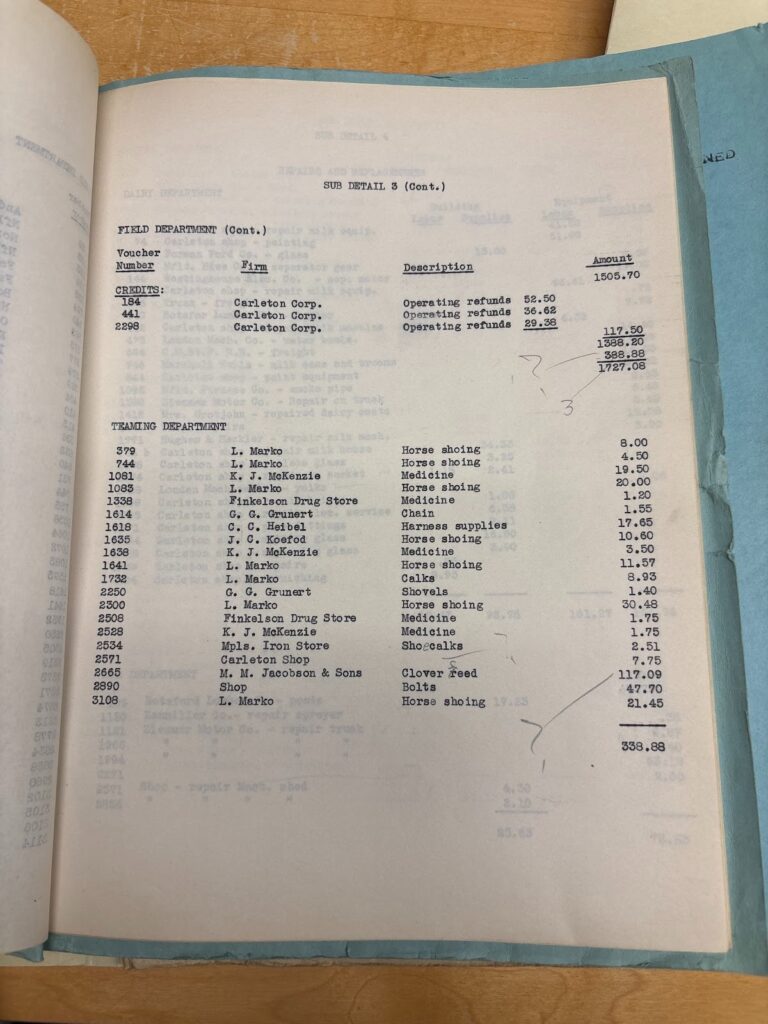
Figure 1: Financial report of the Carleton Farm in 1931 detailing the purchases of the teaming department, confirming multiple transactions for “medicine.”
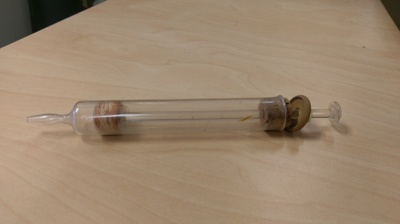
Figure 2: Example of a glass syringe used in the early 1900s.
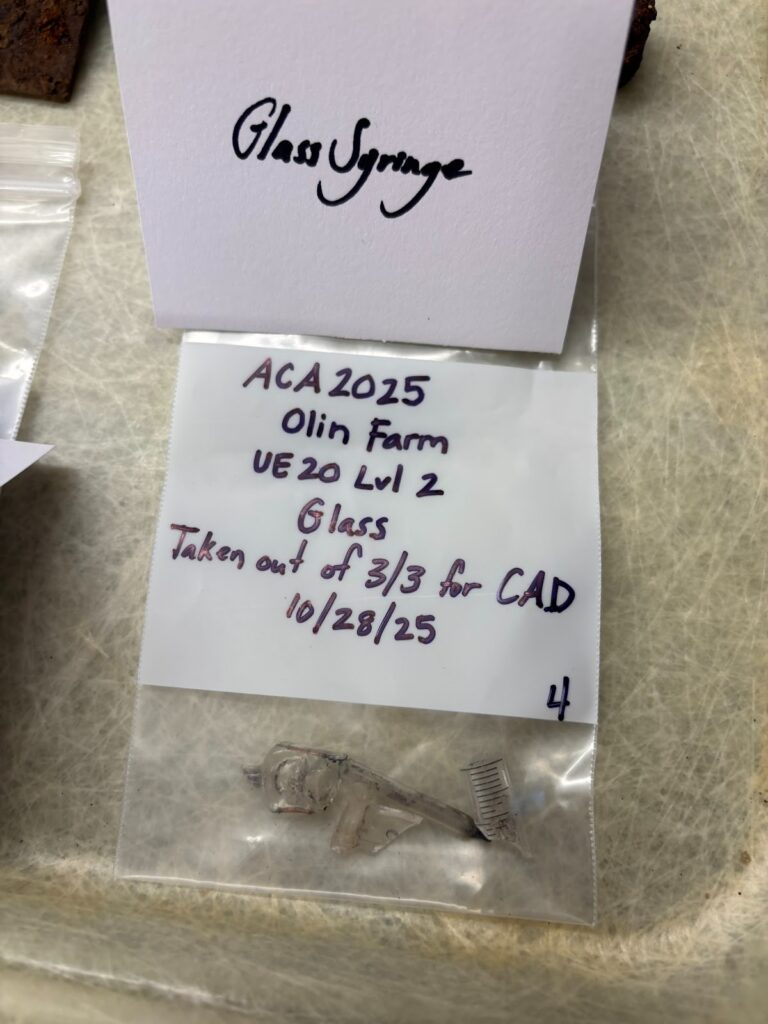
Figure 3: Shards of a glass syringe found in one of our lab’s excavation units.
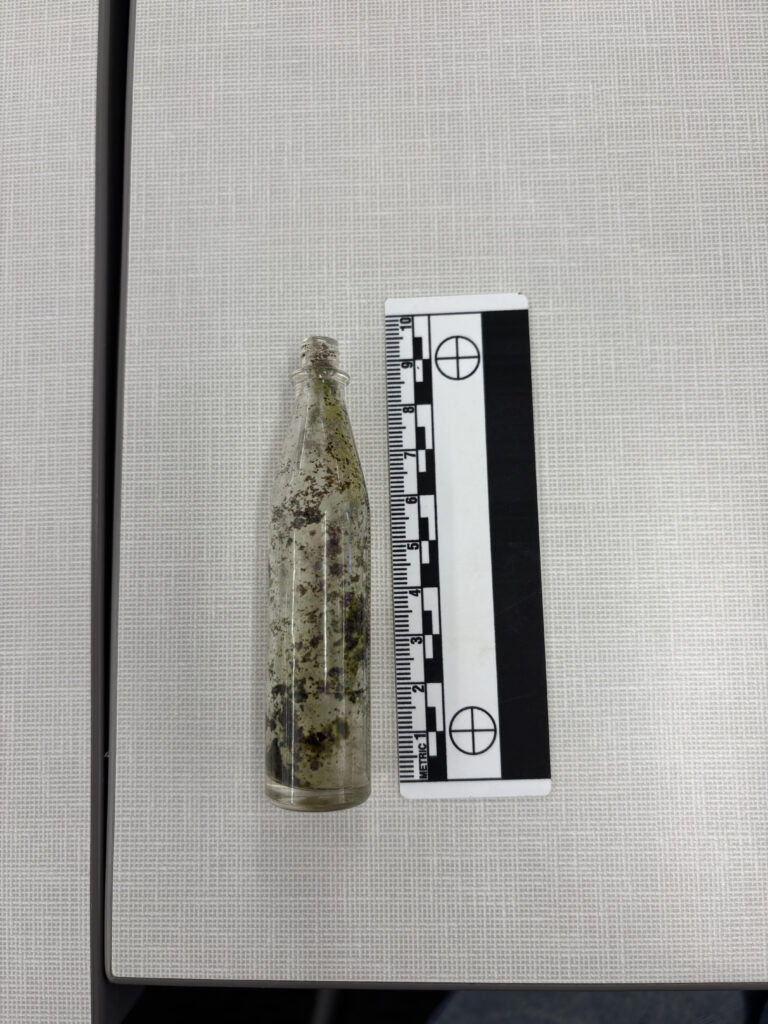
Figure 4: Glass bottle found in a test pit dug in labs. Not pictured in detail: the tiny hole located in the finish of the bottle, perfect for a small needle.
Conclusions
Having looked through all the relevant documents available in the Carleton Archives and traced the ownership of the farm over time, we have found that the main use of the Olin property was as an economic venture. From Alvah M. Olin in the mid 1800s to Carleton today, the owners of the Olin Farm have used the space as a means of generating income, renting it out to community members or Carleton faculty. From the material remains, we have evidence that it was simultaneously used for farming purposes, although we are unsure about the specific dates of when the barn was torn down and the space started being used for dumping.
This project has expanded on information reported by students from the 2022 ARCN246 classes. Most notably, our group has gathered firsthand information from Mark McKone about the intricacies of the farmhouse. For example, the timeline shows that Carleton did not act on its newfound right to sell the farmhouse in 1993, instead opting to continue renting it to Mark McKone. Furthermore, we reveal for the first time, thanks to a conversation with Mark McKone, that the house was used as the setting for a Hollywood horror movie in 2018.
We hope our work will be as valuable for future classes as past projects were for us. Our exploration of the Carleton Archives, along with in-depth research about a few farming-related artifacts we found this fall, provides ample groundwork for classes to continue generating more accurate answers to our research questions. Though we were unable to find out much about the barn, instead focusing on the historical context of farm ownership and the possible usage of a select assortment of artifacts, we hope that future classes will be able to rely more heavily on material analysis, thus improving our understanding of the Olin Farm’s barn.
Works Cited
Anfinson, Scott. “The Archaeology of Northfield.” Northfield: The History and Architecture of a Community, edited by Mary Ann Nord, Northfield Heritage Preservation Commission, 1997, pp. 38-43.
A Timeline of the Olin Family and Farm. In Kennedy, S. A., V. Semmellhack, S. Wege, and M. J. Fielder-Jellsey, eds. 2022. Archaeology in the Cowling Arboretum: Olin Farm. https://archaeologyinthearb.com/a-timeline-of-the-olin-family-history-and-a-history-of-the-olin-farm/
Bayley, Covell. “New Projects to Be Started at Olin Farm.” The Careletonian, vol. XLII, no. 16, Dec. 1921, p. 1. Carleton Archives.
Butler, Sandy. Final Report: Evaluations of and Recommendations for Use of Carleton-Owned Lands Known as “the Arboretum.” 1976, pp. 57–62.
Contreras, D., Negasi, S., and Reynoso, D. 2022. Carleton Farm and the Olin Farm. In Kennedy, S. A., V. Semmellhack, S. Wege, and M. J. Fielder-Jellsey, eds. 2022. Archaeology in the Cowling Arboretum: Olin Farm. https://archaeologyinthearb.com/uncategorized/carleton-farm-and-the-olin-farm/
Dandekar, Hemalata C., and Eric Allen MacDonald. “Preserving the Midwestern Barn.” Barns of the Midwest, 1995, pp. 259-75.
Edstrom, S., González, A., and Jahn, E. Oral Histories. In Kennedy, S. A., V. Semmellhack, S. Wege, and M. J. Fielder-Jellsey, eds. 2022. Archaeology in the Cowling Arboretum: Olin Farm. https://archaeologyinthearb.com/oral-histories/
“Eleven Carleton Men Earn Way Through College By Farm Work.” The Carletonian, 18 February 1922, pp. 3.
Headley, Leal A., and Jarchow, Merrill E. “Carleton: The First Century.” 1966, pp. 50.
“Instrument: Glass Syringe; Ca 1900; AR#1930” EHive, 2025, ehive.com/collections/5254/objects/962289/instrument-glass-syringe. Accessed 20 Nov. 2025.
Kennedy, S. A., V. Semmellhack, S. Wege, and M. J. Fielder-Jellsey, eds. 2022. Archaeology in the Cowling Arboretum: Olin Farm. https://archaeologyinthearb.com/olin-farm-2022/
Lockeretz, William. “Secondary Effects on Midwestern Agriculture of Metropolitan Development and Decreases in Farmland.” Land Economics, vol. 65, no. 3, 1989, pp. 205-16.
Olin Farm. Building Layout. 1 July 1942. Drawer 139, Folder 4. Collection 21: Architectural Drawings and Maps.
Property Records For Olin Farm. 1902, 1912 – 1916, 1930 – 1934, 1993. Box 37, Folder 58. Collection 13: Treasurer’s Office Records.