An Investigation into Sustainability at Carleton by Feiran Wen, Zoe Cheng Pinto, and Jennifer Bricker
Click on the stars above to see images and descriptions of different surface materials at Carleton.
Introduction
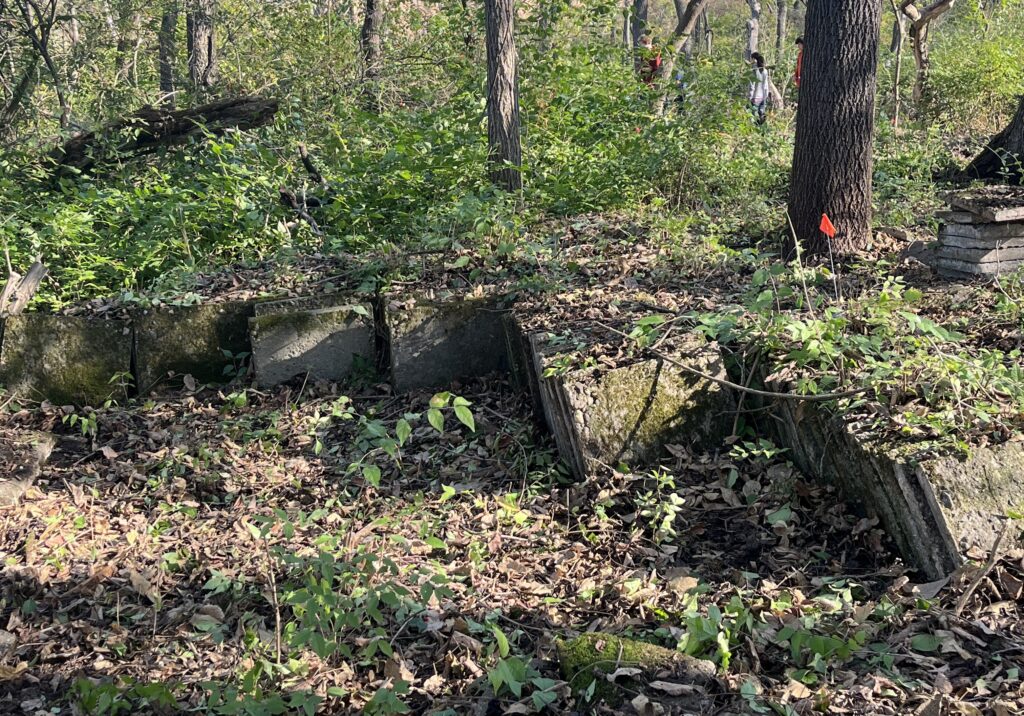
We chose to investigate the history of a collection of tiles found at the Olin Farm Site. These tiles, or pavers, appeared to be made of concrete and were found near the southwest corner of the machine shed foundation. We were interested in determining whether these tiles were left in the arboretum to be used/re-used or if they were intended for disposal.
Below Are the Research Questions That Guided Our Efforts:
- Where did the tiles come from? What was their former and/or intended use?
- What can these tiles tell us about Carleton’s past, specifically about the college’s history of sustainability? What can the tiles tell us about how the Olin Farm site was used after the machine shed’s dismantling?
Preliminary Observations:
Upon first glance, we noticed that the tiles were arranged in seven neat rows and appeared to be deliberately placed in their current position. Evidence of wear also seemed to be the result of continued exposure to the elements, not careless handing. Finally, similar paving materials were and continue to be used around the Carleton campus today.
On the other hand, we recognized that the tiles were left in a relatively obscure spot away from maintenance and facilities buildings. Our investigation into the trash midden established that the tiles were nearby an established dumping set. We furthermore kept in mind that the tiles appear to have been left long ago, at a time when waste disposal practices and levels of environmental consciousness were different from today.
Interview Findings:
We conducted qualitative research as part of our project. We reached out to three former/current employees of the arboretum and a sculpture professor with knowledge of building materials – Nancy Braker, Stephen Mohring, Mark McKone, and Myles Bakke– to see if they could add insight to our project. We were able to interview Nancy Braker, Stephen, and Myles Bakke, all of whom confirmed that the “tiles” were industrial concrete pavers meant for outdoor use, likely for a patio or sidewalk of some kind.
Both Braker and Bakke independently stated that the tiles have been present since before Bakke began as arb manager in 1991, and Braker further estimated that they were likely placed before 1970, based on vegetation growth and the absence of full-time Arb staffing until 1990. Both emphasized that the neatly stacked arrangement indicates the pavers were intentionally saved for reuse, and how sustainability practices in which construction materials were routinely stockpiled rather than discarded. Braker noted the stark contrast between our modern-day culture, where materials are highly disposable, and how much that has changed over the years. Bakke added that there had originally been more tiles and that over the years, neighbors occasionally took some for their own projects. He also noted that when he stared at Carleton, the school was dumping concrete and stone debris in remote locations on campus, until the creation of the retention pond provided the opportunity and budget to recycle/remove the accumulated waste. Braker supplemented this by describing earlier eras of informal material disposal at Olin Farm and elsewhere in the Arb, especially before gates were installed in the late 1960s to prevent cars from driving in to dump trash. Some dumping of landscaping waste does still occur, but thanks to the gate, it is limited to the parking lots outside the Arb. She also highlighted that coordination between construction contractors and Arb staff is a relatively recent development. Historically, such oversight was minimal, likely contributing to undocumented piles like the one we studied.
Together, these interviews support our conclusion that the tiles were deposited in the mid-20th century, likely saved for a now-unknown project, and reflect broader patterns in Carleton’s evolving sustainability and materials-management practices.
Archival Findings:
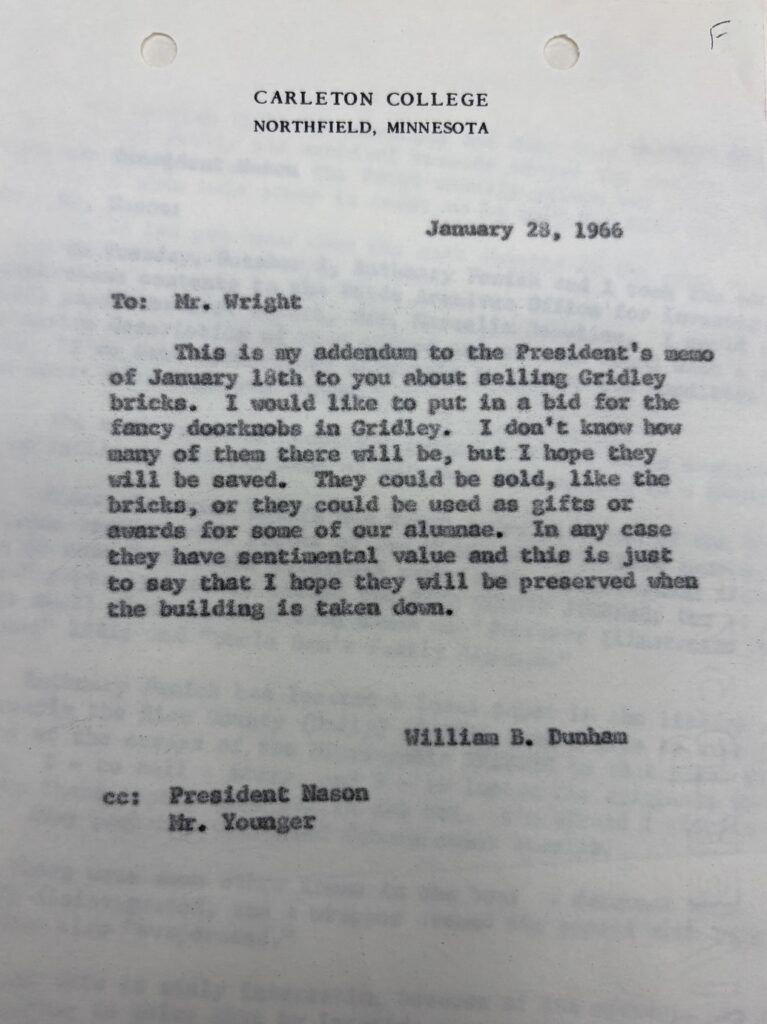
Although we did not find any written record of the tiles, we found historical evidence of different demolition and construction actions at Carleton that shed light on environmental practices over time. In particular, the demolition of Gridley Hall and Mudd Hall provide an ideal comparison to illustrate these changes. For starters, there is no mention of salvaging materials from Gridley Hall for later use in Watson Hall–save for small objects of sentimental or material value. The document below illustrates that at least some desire existed to keep ornate doorknobs and bricks for later sale to interested alumni. In a building contract from this period, it is also said that, “unless expressly specified or indicated on the drawings to the contrary, all materials shall be new and the best of their several kinds.”5 From our look at historical records, it seems that little consideration was given to material reuse.
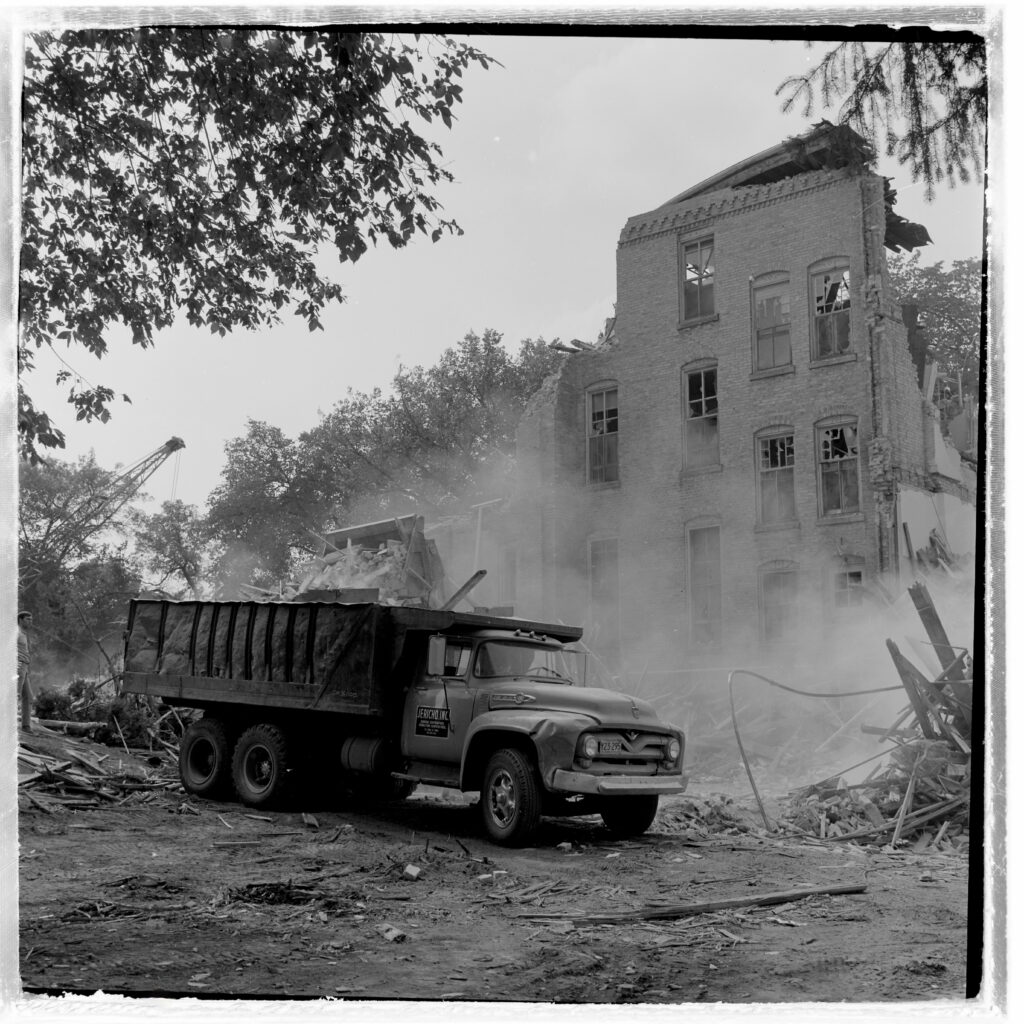
On the other hand, the demolition of Mudd Hall, renovation of Olin/Hulings Halls, and subsequent construction of Anderson Hall show a combined commitment to sustainability and material reuse. In fact, “95% of construction waste from the demolition of Mudd Hall was recycled” and “Carleton reused 78% of existing building materials by renovating Olin and Hulings.”3 In line with Carleton’s stated sustainability goals, the demolition of Mudd Hall and transformation of associated buildings reveal a clear consideration of environmental impact. College administrators balance their desire for modern spaces with an awareness of their actions’ larger consequences.
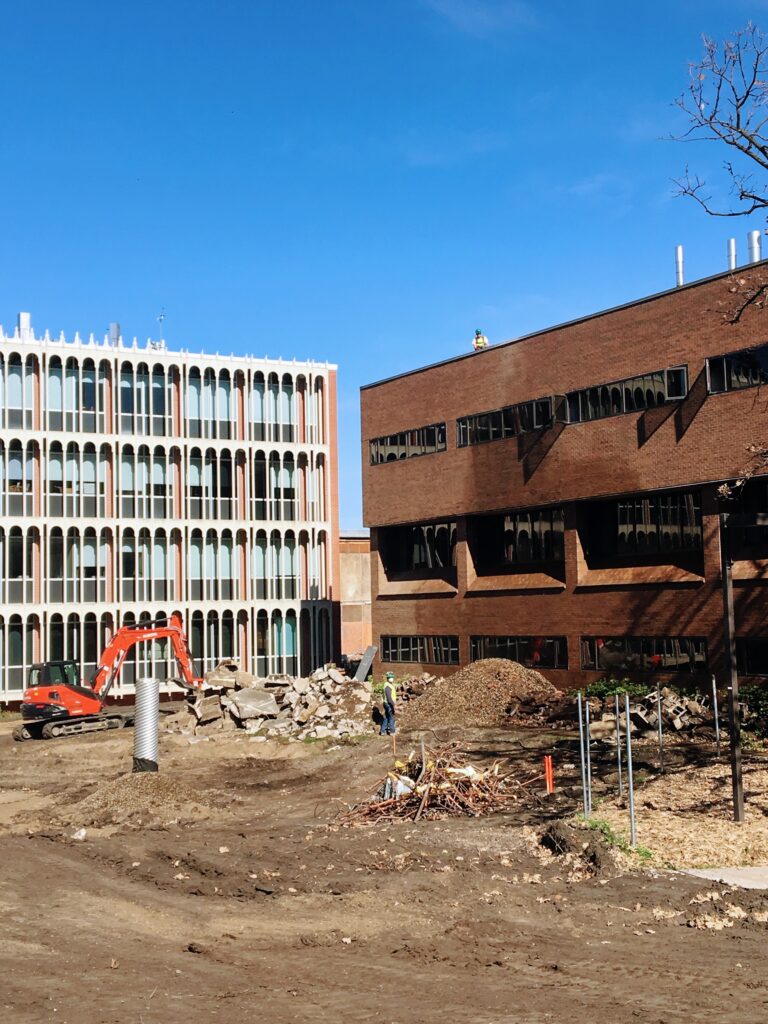
In this photo of Mudd Hall’s demolition, notice the organization of building material categories in preparation for their recycling.4
To determine potential uses for the tiles at the Olin Farm Site, we surveyed 12 locations on campus and made a typology of Carleton Campus surface materials:
| Location Name | size(cm x cm) | color | shape | surface |
| Burton Hall | 241.5 x 252 | Light grey | Square-ish | Slightly coarse |
| Sayles-Hill Campus Center | 9 x 19 | Shadow grey | Rectangular | Coarse. tiny pebbles spread across the surface |
| Leighton Hall | 108 X 196 | Shadow grey | rectangular | coarse. tiny pebbles spread across the surface |
| The Founders Court | 9.5 x 10 | rose quartz | square | smooth |
| Gould Library | – | Cloud grey | pentagon | Coarse. inserted pebbles that make a turtle design. |
| Laird Hall | 9.5 x 18 | Steel grey | rectangular | coarse. tiny pebbles spread across the surface |
| Center for Mathematics and Computing | 99 x 181 | Zinc grey | rectangular | coarse. tiny pebbles spread across the surface |
| Boliou Hall | 135 x 135 | Sliver | square | Slightly coarse. Very thin strip grooves. |
| Olin Hall | 180 x 242.5 | Silver | rectangular | Slightly coarse |
| Anderson Hall | 122 x 152 | Cloud grey | rectangular | Slightly coarse. Very thin strip grooves. |
| Language Dining Center | 140 x 151.5 | Cloud grey | Square ish | Slightly coarse. tiny pebbles spread across the surface |
| Skinner Memorial Chapel | 226 x 241.5 | Cloud grey | Square ish | Slightly coarse |
| Olin Farm | 47 x 47 | Cloud grey | Square | Very coarse. Small pebbles and mosses spread across the surface |
| Women’s League Cabin | 50 x 50 | Cloud grey | square | Very coarse. Small pebbles and mosses spread across the surface |
The surfaces can be subsequently categorized into four distinct types based on a unique combination of texture, color, and context.
| Type | Description | Location |
| Small utility pavers | Small, rectangular, coarse-textured (pebbled), dark neutral greys. | Sayles-Hill, Laird Hall |
| Large utility pavers | Larger (square/rectangular), slightly coarse, light greys. | Anderson, Boliou, Burton, CMC, LDC, Leighton, Olin Hall, Skinner Chapel, |
| Symbolic decors | Unique designs; artistic inlays or polished quartz surface. | The Founders Court, Gould Library (turtle) |
| Historic and Rustic tiles | Square, very coarse with moss, weathered. | Olin Farm, Women’s League Cabin |
Typology Findings and Actions:
From the typology, we determined that the Olin Farm Tiles were not likely used for contemporary campus surface construction. In respect of texture, size, and color, they are most similar to the Women’s League Cabin patios, which were paved approximately in the mid twentieth century. However, the typology demonstrates that the “floor” of the Carleton campus is not arbitrary; it is carefully composed, using different types of concrete pavements to anchor the entrances of the main buildings and embody artistic values.
To engage the public with the history embedded in our campus landscape, we created an interactive map for Community Archaeology Day that challenged participants to match pictures of surface materials to their campus locations. This activity successfully drew students and faculty members into our project, with many noting they had never before noticed the ground beneath their feet. While few completed the entire challenge, we discovered that individuals with longer tenure at Carleton, or those who frequently visited specific locations, demonstrated a stronger familiarity, even though they are not consciously aware of the materials. This exercise prompted a broader reflection on our daily interaction with the college’s material culture and sparked conversations about how these everyday concrete bricks and patios can reveal the evolving sustainability goals of Carleton over time.
Conclusion:
Although the intended use or re-use of the tiles remains unknown, former and current uses of similar surface materials allows us to imagine potential applications for the tiles. We determined that the tiles likely date to the mid- or late twentieth century and were used for some purpose of reinforcement. Furthermore, archival evidence of demolition and construction procedures illuminates changes in sustainability practices at Carleton.
Bibliography and Acknowledgment:
Cheng Pinto, Z. (2025, October 30). Interview with Nancy Braker. personal.
Cheng Pinto, Z. (2025, November 17). Interview with Myles Bakke. personal.
1Dunham, William B. Letter to Mr. Wright. “Addendum to the President’s Memo.” Northfield, MN: Carleton College Archives, January 28, 1966.
3Helgrund, E. (2023, February 1). Building on past successes, Carleton continues commitment to sustainability leadership. Carleton.
2Demolition of Gridley Hall. Sept. 1967. Carleton College Archives. Accessed 16 Nov. 2025.
4Mudd Hall Demolition. 2017. Carleton College Archives, Accessed 16 Nov. 2025.
5Johnston & Sahlman Consulting Engineers. Letter to Carleton College. “Specifications for Electrical Work: Remodeling of Kitchen–Gridley Hall,” August 4, 1961.
We would like to thank Nancy Braker and Myles Bakke for their assistance in helping us learn more about the tiles and Olin Farm Site. We would also like to thank David Bliss and the team of Carleton archivists who helped us located valuable primary source materials. Finally, we are grateful for Professor Sarah Kennedy and ARCN 246: Methods and Lab for giving us the opportunity to conduct research on a topic of interest.