By Ella Parke
Introduction:
As college campuses nationwide were getting involved in Vietnam War protests, it was unsurprising that Carleton College also got involved. However, given the changing gender norms on campus, like the Women’s League Cabin going out of style and female students protesting the hours system enforced by the administration, it is interesting to see how the Vietnam protests displayed how women at Carleton were getting involved and becoming a more active presence on campus.
Methodology:
To begin my research about Carleton’s campus during the Vietnam War, I started by looking at Carletonian articles during the war. I thought this would give me a reasonable basis for the student body’s opinion about what was happening and hear their thoughts through the student-run newspaper. With this methodology, I could understand how the students were fed up with the draft, as there were many op-ed pieces and ads in the newspaper advertising ways to avoid the draft. Although the Carletonian articles were interesting as they gave me a general understanding of the emotions on campus, I could not get the perspective of women directly. I then moved to archival research, focusing on images of protests on Carleton’s campus and interviews with female alumni. Through archival research, I gathered a ton of information about women’s participation in activism and concluded from that information.
Female Participation in Protests:
I discovered a photo of Evans A residents from 1964-1965 through archival research. This image displayed the entirely female floor posing for their hall photo, which I hypothesized would be used in the class yearbook. Most women in this photo wear sweatshirts with the slogan “Get out of Vietnam” or “Stay out of Cuba.”
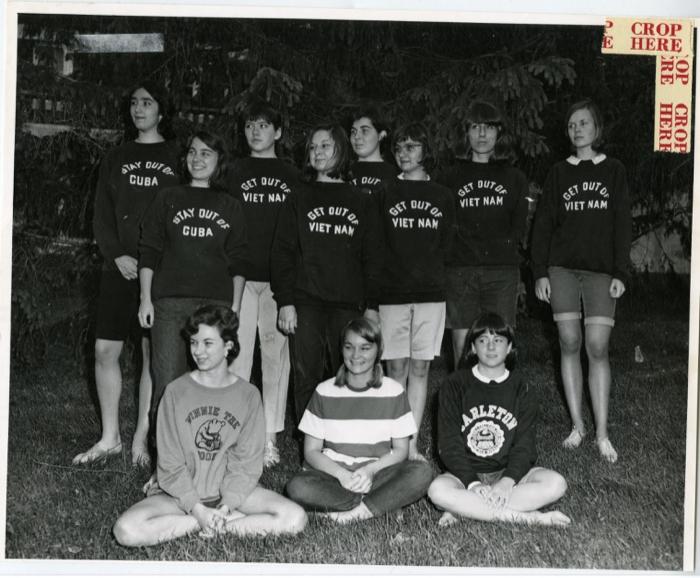
This Evans Hall is fascinating because Evans was also the first of the dorms to entirely protest the hour’s policies mentioned in our write-up on Rules at Carleton. By seeing a group of women posing for their hall photo wearing sweatshirts that they knew would both be provocative to the college and show their stance on the war, we can conclude that women in Carleton were taking an active role in war protests. This photo also displays the overall culture shift that is beginning to happen all over the US with war protests because 1964 was when the protests were becoming more common.


There were also many photos in the Carleton archives of students at protests. These students were both male and female and they were participating in Vietnam protests in the Twin Cities, furthering our point that women were active participants in protests.
In addition, photos from the archives display the change in women’s involvement on Carleton’s campus. There is also an oral interview with an alumnus from 1973 named Alison Woods, who briefly discusses her experience at Carleton during the Vietnam War. In the interview, she says:
“then I remember it was the Vietnam War. Our freshman year, they suspended classes. You remember that? In the spring quarter — I called my Dad, and he was like, “Those white people are crazy. You need to be in class.” I said, “Dad, it’s lit here!” He felt there were far more critical things we needed to do than make posters. But that was Carleton for me.”
(Woods, Alison ‘73).
Figure 3: Quote from Alison Woods ’73, 2021
The line “but that was Carleton for me” displays how protesting was extremely common for women during the Vietnam War. It wasn’t just something that men on campus were participating in.
These three sources display different ways female students on Carleton’s campus were involved in activism during the Vietnam War. They also show the changing gender roles at Carleton’s campus in the 1960s/1970s as women became more active participants and pushed against Carleton’s established systems.
The Women’s League Cabin’s Role in Female Activism:
The Women’s League Cabin was used during World War Two and the 1950s as an outlet for women to go against gender roles and expand their individuality. The cabin’s role in women in Carleton’s lives shifted dramatically when the 1960s came around. The cabin became largely forgotten as women became more involved on campus instead. The cabin’s shift in popularity in conversation with how female students were getting involved with on-campus activism during the Vietnam War furthers the argument that gender roles at Carleton were shifting dramatically. Instead of using the Women’s League Cabin to combat rules set in place by the Women’s League, students stayed on campus to fight the regulations more actively. Women were also getting more involved with what was going on in the rest of the world as they were joining in to protest the draft and the Vietnam War on campus. Although the WLC was not very much used during the 1960s, its being forgotten shows how women’s roles at Carleton changed.

Conclusion:
In the 1960s, female students’ involvement in activism increased immensely as gender roles on and off campus shifted. Carleton’s trend in activism during the 1960s followed a general increase in activism all over the country on college campuses. However, it also displayed how the roles of women were changing. Women at Carleton no longer needed to go to the Women’s League Cabin as they became more involved in on-campus events. In contrast to other war times like World War Two, where the cabin was used as a retreat, the Vietnam War brought out a more aggressive side of activism that targeted the source. In addition to protesting the war and the draft, women at Carleton were also going against the rules for them and changing how they interacted on campus. When female students’ laws and rule resistance are put in conversation with the activism against the Vietnam War, we can see clearly how women were becoming more forceful in getting their way, leading to the destruction of the Women’s League as a whole and the decrease in popularity of the cabin.
Bibliography:
Carleton College. “Alison (Scott) Woods: Interviews for Minnesota Legacy Grant Project Documenting the Experience of African-American Students in Northfield”. 2021. Carleton College Archives. Collection R4-OH, Item 27
Carleton College Archives. Collection 3, Item 1.
Carleton College. “Vietnam War: Northfield Rally”. 1969/1970. Carleton College Archives. Collection 3: Item 22970
Carleton College. “Vietnam War: Minneapolis March”. 1969/1970. Carleton College Archives. Collection 3: Item 22969
Carleton College. “Vietnam War: College Strike”. 1969/1970. Carleton College Archives. Collection 3: Item 22963
Carleton College. “Vietnam War: Minneapolis March”. 1969/1970. Carleton College Archives. Collection 3: Item 23009
Unspecified. “Evans A Residents: Photographic Prints”. 1964/1965.
Unspecified. “Women’s League Cabin use – firewood.” 1943/1944. Carleton College Archives. Collection 3, Series 4, Sub-Series 1943/1944, Folder 10, Item 2.